• Home
  • About
  • Besselink Project
  • Academia
  • Studio
  • Blog
  • Podcast
  • Testimonials
  • Work With Me

Allan Besselink

Golf And Self Talk

Tuesday, 10 April 2012 13:45 Written by Allan Besselink

Sergio GarciaSelf talk has a huge impact on our performance and proficiency, efficacy and effectiveness, in life and in sport. What we tell ourselves, after years and years of programming, defines who we are. We become self-fulfilling prophecies simply by the words we utter within our own minds.

The 2012 Masters gave us a great example of golf - and self talk - all at the same time. Some of it was obvious, some of it less so. Self talk can be reflected in the words that are heard by the media, and sometimes they are found when we read between the lines.

Take three examples: Bubba Watson, Sergio Garcia, and Tiger Woods.

Read more...

The BCS And The Little Sisters Of The Poor

Tuesday, 04 January 2011 18:42 Written by Allan Besselink
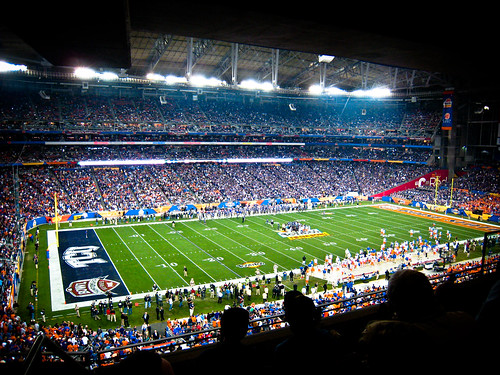
Fiesta BowlGo ahead, NCAA, I dare you: crown a national champion based on an on-field playoff, not political wrangling. It is a pretty straightforward concept that has found a home in virtually all college team sports, including college baseball and basketball.

But, you say, this year’s National Championship game will pit two undefeated teams (Auburn and Oregon) like it is supposed to do. Unless, of course, you have three undefeated teams. Then we have a problem.

I would suggest you might want to ask TCU – the third undefeated team at 13 - 0 – what they think of the affair. Or ask the players what they would prefer to do – to win it on the field, winner take all, or to do it in the polls. I think we all know the answer. In that regard, college football players are not much different than those college baseball or basketball players.

Sadly, what this comes down to isn’t what is right for the student-athlete. It is a simple issue of the haves and the have-nots of college football. Or, as Ohio State University president E. Gordon Gee stated, “very fine schools” (presumably Ohio State is in that category) versus “the little sisters of the poor” (TCU and Boise State as but two examples).

Yes, those are Gee’s words. They epitomize a mentality that is at the very heart of the idiotic Bowl Championship Series. And that is only scratching the surface. Look no further than Gee and his employer – the Ohio State University – to find an example of the hypocrisy behind the BCS.

Read more...

Monday, 09 April 2012 16:46 Written by Allan Besselink

Nervous systemDoes McKenzie’s derangement syndrome fit into a traditional patho-anatomical model? And if not, does it matter anyways?

With the derangement syndrome, we witness lasting changes in movement characteristics, strength, reflexes, and dural signs after the performance of directional preference movements. Mechanical and symptomatic responses to mechanical loading strategies, consistent with the operational definitions of McKenzie’s derangement syndrome, exist throughout the musculoskeletal system. The problem lies in providing a clear and consistent systemic or anatomical foundation to explain the phenomenon.

It is my proposal that the central nervous system may in fact provide the basis for McKenzie’s derangement syndrome, and may also provide yet another reason for MDT as a systems-based approach to musculoskeletal care.

Read more...

Cream, Clapton, And The Celica

Saturday, 01 January 2011 17:45 Written by Allan Besselink
King of the Delta Blues SingersWhen I was a child, my parents and I went on a lot of road trips. While logging many miles on the highways of Canada and the United States, we listened to a lot of music.

There was one particular road trip that stands out in my mind. It is a vivid recollection – not of the destination itself, but of the impact a few precious moments in time had on me during that trip. Funny thing is, those precious moments were in our driveway.

I think I was probably about 14 years old, maybe a little older. The dates escape me. We were just arriving in Brockville after returning from a road trip to points lost in memory. I was sitting in the back of our silver Toyota Celica. My parents always occupied the front seats – I had the back all to myself.

We had just pulled into our driveway when a song came on the radio. I distinctly remember that the first few chords stunned me. My father was just about to take the key out of the ignition and I remember asking him to keep the radio on until the end of the song.

The song? It was “Crossroads” – a live version recorded by Cream on March 10, 1968 at the Winterland Ballroom in San Francisco. At this moment in time, I was exposed to Eric Clapton’s stunning solo in this Robert Johnson classic. I’d never heard anything like it. Crossroads. Wow. There was something absolutely magical about it.

I was floored. I realized that I had to find out just who this Robert Johnson was. What I was to discover was that nobody really knew.

Read more...

The Paradox And Perceptions Of Money And Health

Friday, 06 April 2012 23:17 Written by Allan Besselink

051307 145There is an intriguing perception of money and its relationship to health in our community. For many, spending more money on some item or service equates to the perception of a higher quality of service. There are some very interesting cost dynamics and perceptions that take place in health care as well.

There is a commonly-held perception that if a personal trainer or coach is more expensive, then they MUST be good. We see the same in the world of health care – the greater the cost (or the longer the waiting list), the better the provider must be. But where are the outcomes? Accountability? Results?

In most businesses, good quality work and/or service is rewarded with economic prosperity. You provide a good outcome, and you do well economically. You provide a lousy outcome (on a regular enough basis), and you are looking for a new career. But for some reason, these basic rules of capitalism (and quality) seem to change when there is any mention of “health”.

Read more...

More Articles...

  • When Music Meets Life: The Beauty Of The Vibe At ACL
  • Training Myths: The Recovery Run

Page 87 of 167

Start
Prev
81
82
83
84
85
86
87
88
89
90
Next
End

RunSmart Book

Where To Buy RunSmartUp to 60% of runners will sustain an injury within any given year. Poor running mechanics, in conjunction with poor, ineffective and outdated training methods, can pose a significant injury risk. "RunSmart" was written to address these issues in the running community.

Featured Chapter

Clinical Orthopaedic Rehabilitation "Running Injuries: Etiology And Recovery- Based Treatment" (co-author Bridget Clark, PT) appears in the third edition and fourth editions of "Clinical Orthopaedic Rehabilitation: A Team Approach" by Charles Giangarra, MD and Robert C. Manske, PT.

Subscribe Now!

BP Manifestos

  • Smart Health Revolution
  • Vision Now

Most Popular Posts

  • The Deafening Silence
  • Three Common Examples Of Self Image, Self Sabotage, And Comfort Zones In Action
  • Patient Access To Physical Therapy And Groundhog Day
  • Evolution Or Revolution?
  • Learning How To Live
  • The Homeostasis Of Writing
  • Why HB 1263 Matters
  • The Flow Of Running, The Flow Of Life

Subscribe To My Newsletter

Allan Besselink

Allan Besselink, PT, DPT, Dip.MDTAllan Besselink, PT, DPT, Ph.D., Dip.MDT has a unique voice in the world of sports, education, and health care. Read more about Allan here.

PT Blog Awards

Top 5 finalist in three categories: "Best Overall Blog", "Best PT Blog" and "Best Advocacy Blog".

Connect With Me

PO Box 26161
Austin, TX 78755
512-222-6263


Copyright 2006-2023 Allan Besselink  | Terms Of Use | Privacy Policy |  Disclosure Policy |  FAQ

Powered By Mobius Intermedia