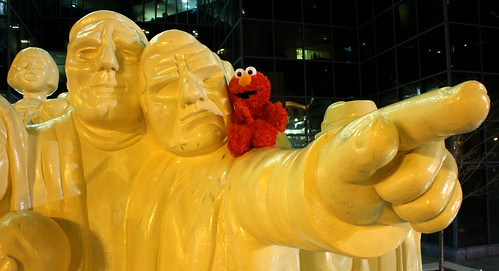
 There is a lot of finger pointing that goes on in health care.
As a physical therapist, I have to look no further than members of my own profession. Many physical therapists point their fingers at chiropractors, claiming that they see patients more frequently and far longer than they need to be seen. Or that they use passive approaches and dis-empower patients. Or that all they do is manipulate, and that chiropractors think it is a solution for everything.
I have heard the diatribe many times before, and I am sure I will hear it many times again.
Of course, when you point a finger at someone, three point back at you. As for what happens to the thumb, we can discuss that later.
What this amounts to is that there is crap to be found in every profession. It is not just in someone else’s profession, not just on the other side of the fence. It is in your own backyard. The bell curve of clinical excellence has outliers on both sides. It is where we put the focus that is the problem.
This isn’t exclusively a physical therapist dilemma. All health care professions do it, oftentimes due to a lack of education and understanding, or simply a desire to protect their own highly-coveted turf that they have worked so hard to attain.
I have worked alongside many great clinicians over the years. I have worked with great chiropractors – and lousy ones. I have worked with great physicians – and lousy ones. And perhaps most importantly, I have worked with great physical therapists – and lousy ones. And all points in between.
Clinical excellence really is like a big bell curve. On one hand, the far left side of the curve, are the outliers that represent “ignorance is bliss”. They don’t know what they don’t know. They may have become a clinician purely as a means of generating a healthy income. They might pursue continuing education, but more so because licensure demands it than any other reason.
On the other hand, the far right side of the curve, are the outliers that represent “visionary clinical excellence”. These are the clinicians that “get it”. They understand the dynamics of patient interaction and the health care system. They not only read the research, but they sift through it and integrate it. They realize that “health care” is all about the patient, and not about the clinician. They are prepared to challenge their own beliefs in order to find a better way for the patient, and not to appease themselves.
And there is the vast majority in the middle of the curve.
Let’s face it – health care is no different than many other professions. There are good and lousy Honda technicians. There are good and lousy Xerox copier salesmen. But in professions other than health care, if you don’t bring your “A” game, you are looking for another job. In health care, you can provide care by the procedure, not necessarily provide a good patient outcome, and be reimbursed very well indeed.
Pointing fingers at another profession isn’t a problem if the evidence is there. Fair enough. But as the saying goes, if you live in a glass house, do not throw stones. Hey PTs – don’t point fingers at chiropractors when you yourself continue to use passive modalities in patient care, fail to apply appropriate therapeutic exercise progressions based on cellular physiology, and continue to utilize techniques not based on evidence but on “they work, because I make people better and I know so”.
So who should we look to for leadership? For solutions?
Unfortunately, professional associations tend to not be led by the outliers on the far right of the curve – the visionaries, those that want effective change and have a way to do so. They are led by the far and mid-left of the curve, those that want the status quo upheld at all costs. We see it in clinical care and in the reimbursement policies for that same care. We see it at all levels, from state to federal.
Regardless of your health care profession, it is our professional responsibility – better yet, our responsibility to the patient – to provide evidence-based strategies for care. Now, it is not only an ethical responsibility, but a fiscal one as well in an economically-failing health “care” system.
If you don’t agree, no worries. Let’s not have any of our health care professions gravitate to the lowest common denominator of care. Lead, or get out of the way. It is the least we can do for our patients.
Photo credits: Photo-fenix.com

 Up to 60% of runners will sustain an injury within any given year. Poor running mechanics, in conjunction with poor, ineffective and outdated training methods, can pose a significant injury risk. "RunSmart" was written to address these issues in the running community.
 "Running Injuries: Etiology And Recovery- Based Treatment" (co-author Bridget Clark, PT) appears in the third edition and fourth editions of "Clinical Orthopaedic Rehabilitation: A Team Approach" by Charles Giangarra, MD and Robert C. Manske, PT.
 Allan Besselink, PT, DPT, Ph.D., Dip.MDT has a unique voice in the world of sports, education, and health care. Read more about Allan here.
 Top 5 finalist in three categories: "Best Overall Blog", "Best PT Blog" and "Best Advocacy Blog".
PO Box 26161
Austin, TX 78755
512-222-6263


